

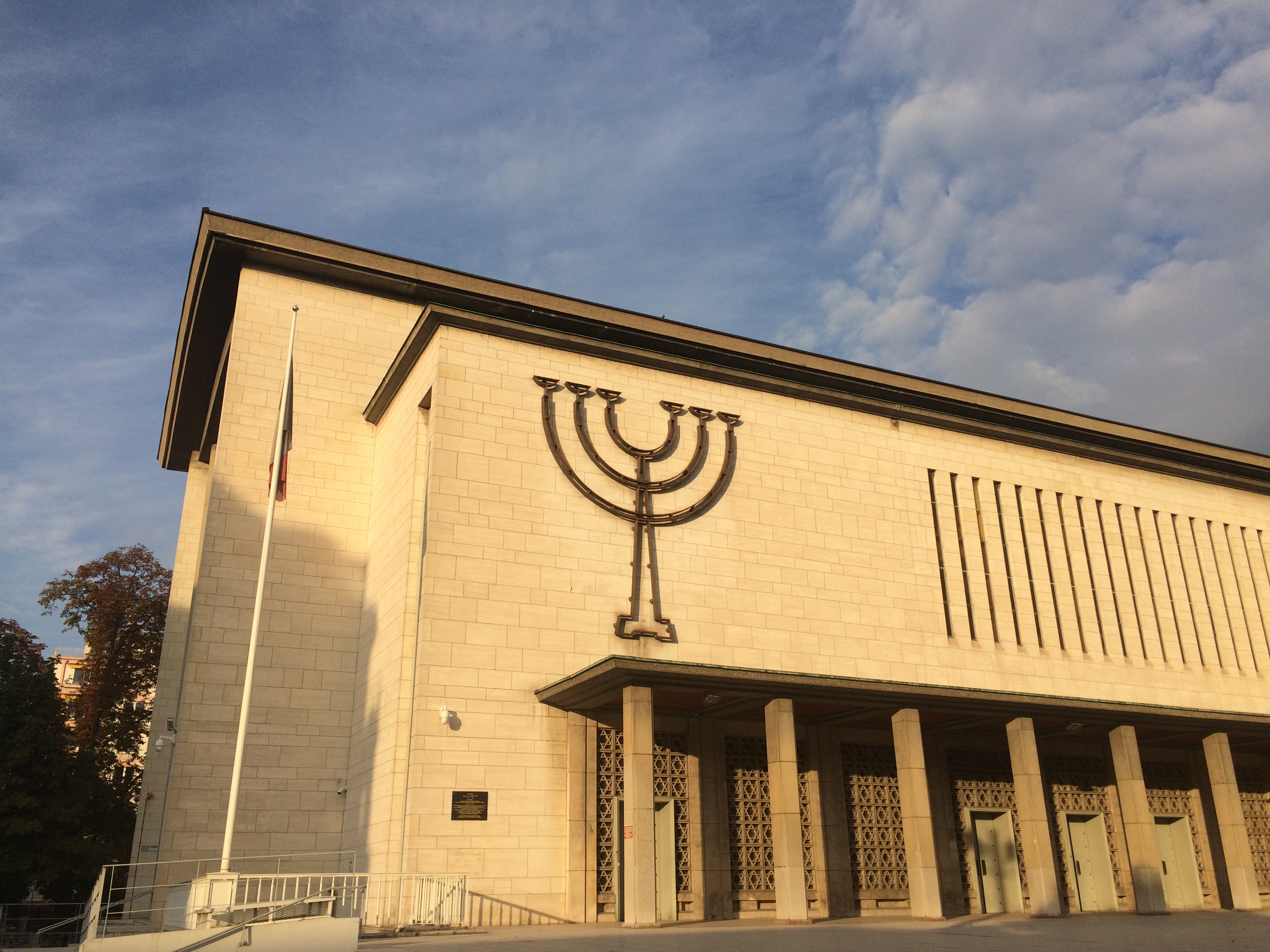
This piece was written to depict my childhood temple.
September 2017
“We have to laugh at his jokes because they haven’t been around for a while” my mom said to me quietly. My dad had just made a joke that was something about how a nose would go on strike and that now it would have to “picket.” My dad has been known to be hilarious, and people have always asked my mom: “do you just sit around and laugh with Russ?” She would roll her eyes in response, because sometimes his jokes are dumb, or just distracting and unnecessary. But the laughter he brought into the house was part of the sweetness of my home. My dad, in another room, entertaining himself by playing harmonica mediocrely and singing Ray Charles loudly over the sound of the heat humming and our parakeets chirping. His humor has taken us on numerous adventures: last year, he found someone on Facebook with his same first, middle and last name and we went to meet him in a brewery mostly because he thought the whole thing was so hilarious. However, in the past few months, my funny dad has been absent, struck down by this powerful anxiety disorder that my brother and I also battle. The debilitating anxiety has strands throughout my Jewish family (my dad’s side), as his grandma was institutionalized for a large portion of her life and his sister lived a solitary, quiet life that was dictated by her powerful anxiety. A therapist once told me: “Anxiety is the opposite of joy.” It causes me to detach from my surroundings, and hyper-analyze everything, in opposition to humor, which comes from relaxing and enjoying the absurdities of the world. We missed my dad’s wacky antics, and watching him, I wondered how much of that humor was tied to his mental illness. The intersection of these two, seemingly opposite forces seems extremely prominent in the Jewish community I have grown up in. As a Jewish person, it seems clear to me that Judaism and mental illness seem to go hand in hand. I am not sure if that is a fact, but all of the families in my Jewish community had a disproportionate amount of mental illness. In comparison to my friends from high school, the difference was obvious. I plan to do more research on this, and how trans-generational trauma influences present-day Jewish mental illness.
I walked into my Temple Friday night for Shabbat services. I grew up going to Sunday school at Kol Ami, had my Bat Mitzvah there and was on the board of the temple youth group, KATY (Kol Ami Temple Youth). I walked in with my best friend from Temple, Sarah, and my parents. I had dragged them all to services because I wanted to go while I was home for the weekend. Rosh Hashana had been the day before, so we knew there wouldn’t be that many people at services, but we weren’t expecting to be four of the ten people in the sanctuary. We immediately felt uncomfortable, and Sarah joked “do you think anyone would notice if we left?” Following us, walking in Mark, this older man who had a long standing issue with my parents that we never really understood. He really hated them though, and gruffly looked away as my dad said “Hi Mark.” He walked in with three drums and Sarah, again leaned over to say “no service is complete without bongos.” Everyone there had been members since we had gone to Temple there, and they introduced themselves to us, we thought this was strange as we knew all of them, and had been to Shabbat services many times over the summer. The cantor asked our majors and when Sarah said she was an English major he said: “we always need more English majors” sarcastically. The Rabbi was off for the night because she had been spent from running the Rosh Hashanah services. The cantor began, saying, “so, we got two college students and a snarky rabbinical student” and motioned towards an elderly woman with a cane in the front row. The services started with the cantor on guitar, a flautist, a drummer and about five people in the audience. As the songs started, two people entered, dressed in steam punk outfits. The woman had on all different shades of purple, a top hat and small wire brim glasses and the man had a large mustache, a news boy cap and all different shades of green on. I whispered to Sarah that they looked like Oliver Twist characters. It was the first day of Fall and the Cantor, Asher, took over most of the service, and asked the audience what they have noticed of Fall. He said “there is that one smell outside, have you been smelling it?” The ‘snarky rabbinical student’ yelled out “it’s called mold!” Sarah and I would laugh at all of these interactions, as they seemed wildly casual for a Shabbat service. When we were singing the prayer to welcome the Sabbath bride, the cantor said: “imagine, this feminine energy that is the Sabbath, walking in, have you ever seen someone so beautiful?” Someone retorted “I’d like to think I have!” It was our old Sunday school teacher, husband to the flautist, who had brought in a rocking chair and was wearing a purple kippa balanced on the side of his head and a matching purple University of Washington sweatshirt. After this, the cantor slowly played on his guitar, while our nemesis played bizarre drum solos on his small drums. The cantor spoke about angels and said: “My mother told me that she saw an angel once, and the angel was so tall that when she looked at it, she could only see up to its knees. Should I believe her?” a man listening emphatically said “YES! you believe her!! It’s your mother!” Throughout the whole service, Sarah and I sat with our shoulders shaking, trying to hold in our laughter.
Later, we told Sarah’s dad about this service and he said that the older woman’s name is Rocky Chipchowski and that “every time Rocky sees me, she throws her arms around me and kisses me on the lips!”

 Glaser Media + Writing